A man who turned weeds into a worldview
I keep coming back to Yule Gibbons because he feels less like a single biography and more like a weather system. He moved through the twentieth century carrying a basket of wild plants, a radio-ready voice, and a stubborn faith that the overlooked world was rich enough to feed both body and imagination. His name still carries the faint crackle of midcentury America, when appetite, advertising, and self-reliance collided in the same living room.
What interests me most is not just that he wrote about edible plants. It is the way he made foraging feel like a philosophy with dirt on its boots. Yule Gibbons did not present wild food as a novelty. He treated it like a memory waiting to be recovered, like a door in the hedgerow that most people had walked past for years. In his hands, a roadside ditch became a pantry, and a patch of weeds became a lesson in attention.
From homestead hardiness to public curiosity
Yule Gibbons was born in 1911 and grew up in a world shaped by movement, labor, and necessity. His early years were marked by rural life, family knowledge, and the kind of practical education that does not come from books first but from kitchens, fields, and weather. That background matters. It explains why his later work had such confidence. He was not inventing a rustic pose. He was drawing from a life that had already taught him how to listen to land.
His childhood and youth also came with the rough edges that often produce memorable people. He worked across different trades and roles, and that variety gave his writing a broad human texture. He was not a sealed-off expert in a narrow specialty. He was a drifter, builder, laborer, and observer. That mix mattered because foraging itself demands range. You need patience, memory, and a little grit. You need the discipline to look closely at ordinary things until they stop being ordinary.
The book that opened the gate
When Yule Gibbons published Stalking the Wild Asparagus in 1962, he found the exact hinge between appetite and curiosity. The book did more than describe edible plants. It suggested a different way of moving through the world. I read that kind of writing as a kind of field music. It changes the rhythm of your steps. You stop charging through the landscape and begin to notice the edible, the medicinal, the surprising, the ignored.
That was part of his appeal. He wrote with an accessible tone, but the tone carried conviction. He made wild food sound democratic. You did not need a laboratory or a grand estate. You needed your eyes, your senses, and enough respect for the plant world to avoid foolishness. In a culture growing more urban and processed by the year, that message landed like cold spring water.
The book also helped establish the template for his public image: part guide, part storyteller, part wilderness evangelist. He was the man who could make asparagus sound ancestral. He suggested that a field margin might contain more value than a supermarket aisle if only people had the patience to kneel and look.
Television, advertising, and the odd fame of an outdoorsman
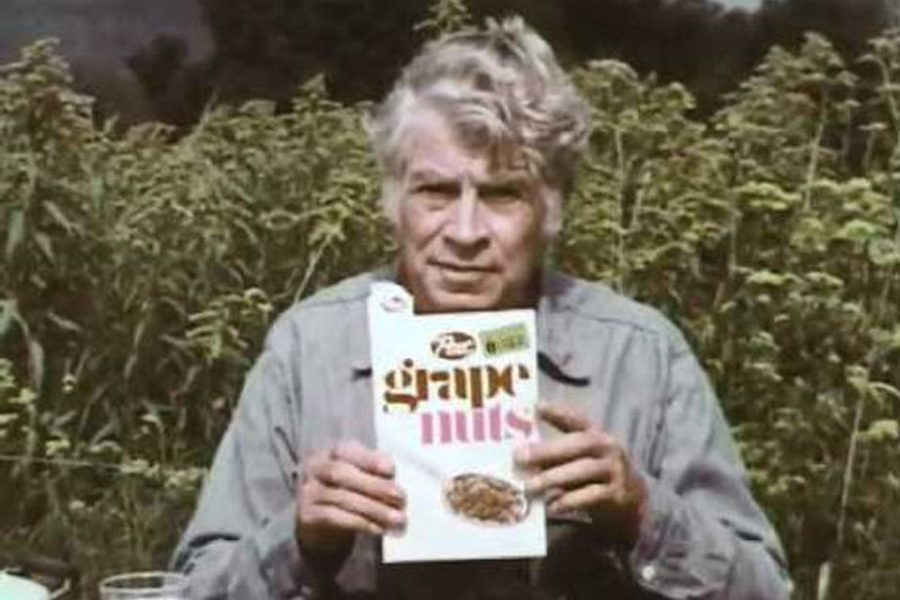
Yule Gibbons became more than an author because television and advertising gave him a second life. The Grape-Nuts commercials made him instantly recognizable, and that visibility altered the size of his legend. A man who wrote about wild foods was suddenly speaking to the nation through a cereal box lens. It was an unusual marriage of authenticity and commerce. I think that tension is part of what keeps him interesting.
He was not simply “the wild food guy.” He was a performer who understood timing, phrasing, and image. That mattered in the 1960s, when American culture was both celebrating abundance and quietly craving simplicity. He stood in the middle of that contradiction. On one side was the packaged, polished world of postwar consumption. On the other was the older, humbler world of gathering, cooking, and making do. He translated between them.
There is something almost theatrical about the contrast. He could be on camera talking about wild plants while the nation was being sold convenience in bright, modern packages. That contradiction gave him a peculiar kind of authority. He looked like a man who knew what could be eaten when the shelves were bare, and that made his words feel sturdier than the studio lights around him.
More than a forager, less than a simple icon
The public image of Yule Gibbons can flatten him if I am not careful. It is easy to turn him into a charming relic, a quirky promoter of roadside salads. But that misses the wider arc. He had political interests, intellectual shifts, and a life that did not stay pinned to one ideological corner. He passed through radical politics in earlier years, later moved away from it, and eventually embraced a Quaker direction in life. That evolution matters because it shows a person still in motion, not a statue in a grocery aisle.
He also spent time at the University of Hawaii and picked up work in unexpected forms, including crossword puzzle composition. That detail feels perfect to me. It fits the profile of a mind that liked patterns, wordplay, and the hidden structure beneath surfaces. Foraging is a form of pattern recognition. Crosswords are too. Both depend on seeing what others have overlooked.
His later years also included honors and continued visibility. He was not simply a one-book wonder frozen in a single decade. He kept writing, kept moving, and kept refining the public version of himself. That persistence gave his life a strange dignity. He made a career out of the edges and never entirely returned to the center.
Family life and the quieter scaffolding underneath the legend
The family story is smaller in scale than the public story, but it gives the man more shape. Yule Gibbons was married first to Anna Swanson, and later to Freda Fryer. He had two sons, Ronald and Michael. Those facts remind me that every public figure is also a private citizen, stitched together by ordinary obligations and domestic weather.
Family life often disappears behind the louder myth, but in his case it should not. A man who spent so much of his life identifying useful things in the wild also lived among relationships that required patience, adaptation, and survival of a different kind. Marriage, parenthood, partnership, and home are not as photogenic as a basket of greens, but they are just as revealing.
I picture the family story as the root system beneath the visible plant. You see the stem, the leaves, the book, the commercials. Underneath, there are households, disagreements, shared meals, and the long work of making a life that can hold both motion and attachment.
Why Yule Gibbons still lingers in memory
Yule Gibbons still matters because he anticipated a mood that has only grown stronger. People continue to reach for local food, seasonal eating, herbal knowledge, and the romance of self-reliance. He stands at the beginning of that current, waving from the bank with a field guide in hand.
He also matters because he was never just a mascot for rustic living. He was a hybrid figure, half naturalist and half media personality, with a trace of the salesman and the preacher mixed in. That blend makes him feel modern in a strange way. He understood that ideas travel better when they have a face, a voice, and a memorable line attached to them. He also understood that a public appetite can be shaped by charm as much as by argument.
I like figures like that because they resist easy filing. Yule Gibbons was not a saint of the woods, nor just a carnival act in a nature hat. He was a man who found a language for abundance in places most people ignored. That language still has a pulse.
FAQ
Who was Yule Gibbons?
Yule Gibbons was an American writer, outdoorsman, and media personality known for popularizing wild-food foraging and for turning edible plants into a popular subject for a broad audience.
Why is Yule Gibbons remembered today?
He is remembered for blending practical foraging knowledge with a strong public persona. He helped make wild foods seem less eccentric and more like part of an everyday American landscape.
What made Stalking the Wild Asparagus important?
It became the book most closely associated with his name and helped define his reputation. It treated wild foods as something accessible, useful, and worth noticing rather than as a curiosity.
Was Yule Gibbons only a writer?
No. He was also a public figure, a commercial personality, and a man whose life included labor, travel, education, and a range of interests beyond publishing.
Did Yule Gibbons have a family?
Yes. He was married twice, first to Anna Swanson and later to Freda Fryer. He had two sons, Ronald and Michael.
Did he have any other unusual skills?
He did. One especially interesting detail is that he worked at times composing crossword puzzles in Hawaiian, which fits his taste for patterns and language.
Was he involved in politics?
Yes. His life included an early period of left-wing political involvement, followed by a later shift away from that path and toward Quaker life.
Why does his story still feel relevant?
Because he anticipated many modern interests: foraging, local food, sustainable living, and the appeal of practical knowledge. He still feels like a man standing between old habits and new cravings.
Making Westfield Cleanup Less Chaotic With The Right Dumpster
A Fresh Look At California Luxury Rehabilitation
How To Turn A Boring Sale Into A Video People Actually Watch
Park City Comes Alive Through Art Music And Mountain Culture